Monthly Archives: June 2024

Passing: The Trips Game
There is a pile of passing game tutorials and explanations available online for anyone who wishes to forage through it, but I’ve found the plays discussed in clinics and tutorials tend to be disconnected elements of the playbook offerings available. Making these concepts harmonize with a direct snap, run-oriented system can be challenging. We want our passing plays to be integrated, where one sets up the other, and each play is complimentary. Similar to our running plays, we want all the plays to start out looking the same, from the same set, then have them be able to attack the defense in different ways. For us, this renders the concept of a “route tree” as just noise adding useless complexity. We don’t need nor do we even want 729 (9^3) possible route combinations. Getting enough reps to run, let alone learn, a tiny fraction of that number is not realistic with only about 300 total passing practice reps available before the first game.
We have three well-established, proven, core passing plays out of our single wing Red and Blue set. But to evolve our passing game, we added a trips look that we think gives us more options to stress the defenses we face. But again, we don’t want to add a big bag of dozens of plays to that set. We want a tidy package of inter-related ones, a list reduced and simplified as much as possible. The greater the simplification, the easier the learning and the execution.
The defense dictates what the appropriate route combination and passing concept should be used, so we started our analysis there. We painstakingly logged every defense aligned for every play we ran out of our trips set for the entirety of our 7th grade season. We came up with 12 different defensive alignments (16+ if you count all the nuances in depth and width).
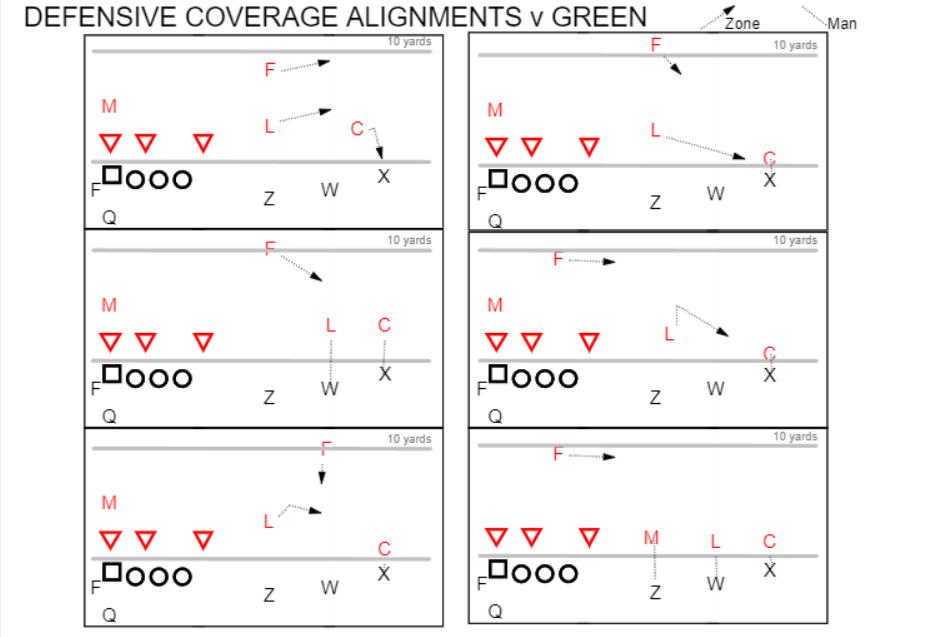

To simplify this, we created a box within the diagrams in front of each receiver. These boxes extend inside of each receiver to half the distance to the next receiver and then down field for ten yards. If a defender aligned in the box, the box was assumed “capped” or “covered” and was colored red. If no defender was aligned, we made the box green. We resolved to 5 box combinations:
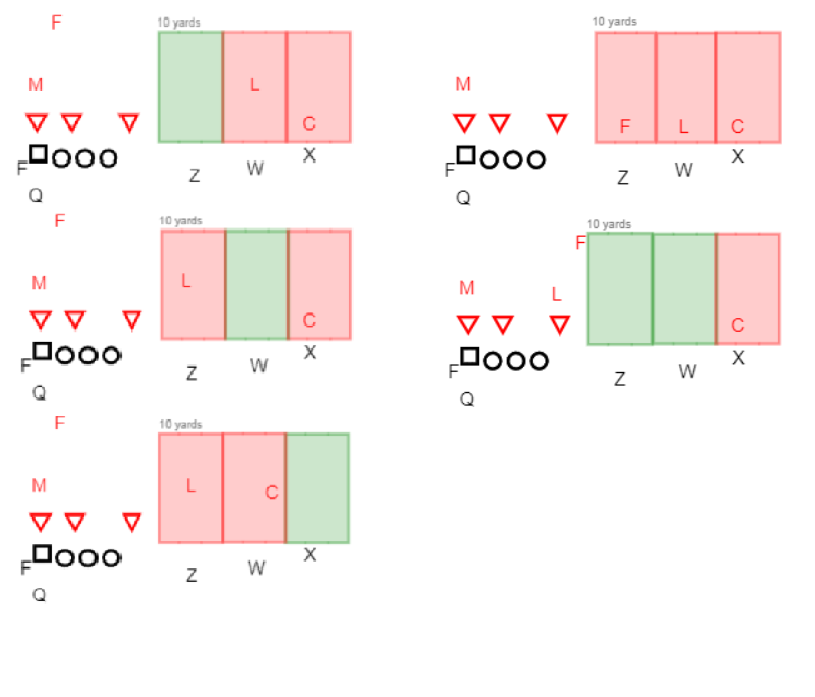
What we’re left with is a simplified key, or matrix, for play calling. If a coach or the QB can identify the occupied and empty boxes, he can make a play call that maximizes our chance for success by putting one defender into extreme conflict, creating spacing for a receiver, running an obstruction/rub/pick route combo, audibling to a running play, or throwing to the short side. Using the routes we already practice, we came up with the following options:

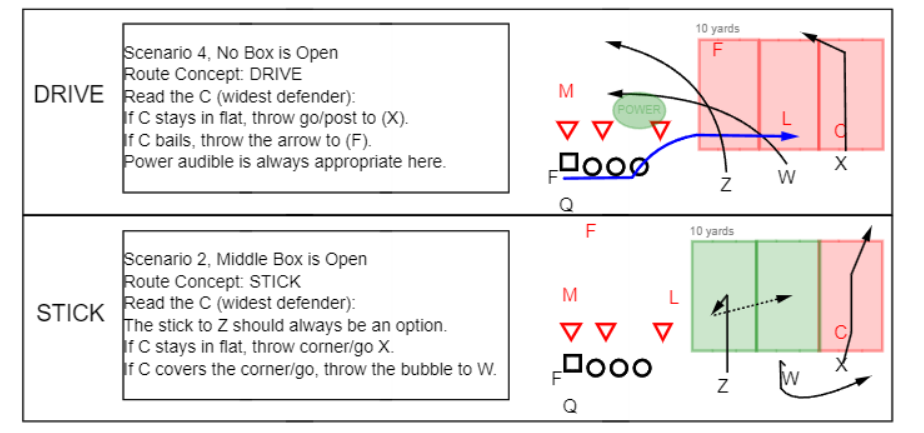
The 5 scenarios are all simple reads and call one of 4 route combinations (STICK is used twice). We’ve noticed that the SNAG leaves the bubble significantly open most of the time (62.5% on 25 of 40 times run). That’s a direct function of pulling the cover 3 CB off with the W or the CB playing too soft. So you’re probably never wrong running SNAG unless they have manned up all three receivers. If they do that, we would run all three off with DRIVE and slip the F into the flat on an arrow route. The Power audible is a tasty option if their LB is wide and if they bring 2 CBs over, then that should be an automatic Y CORNER to the short side. We’re just going to take what they give us. These are all fast-developing routes, breaking at 5-7 yards. We don’t have a lot of time… maybe three seconds.
Now, we have not installed this, yet. This is just a concept. If we are not comfortable with the Q calling pass audibles every play, we will assume their alignment from the previous play and send the play in. Or, we can read it from the sideline and hand signal the Q. Either way, we are going to give it a try. If it works, I’m going to add it to the SSSW playbook. We’ll see.


 Sidesaddle Single Wing Football