Category Archives: Coaching Ideas

Practice Essentials (1)
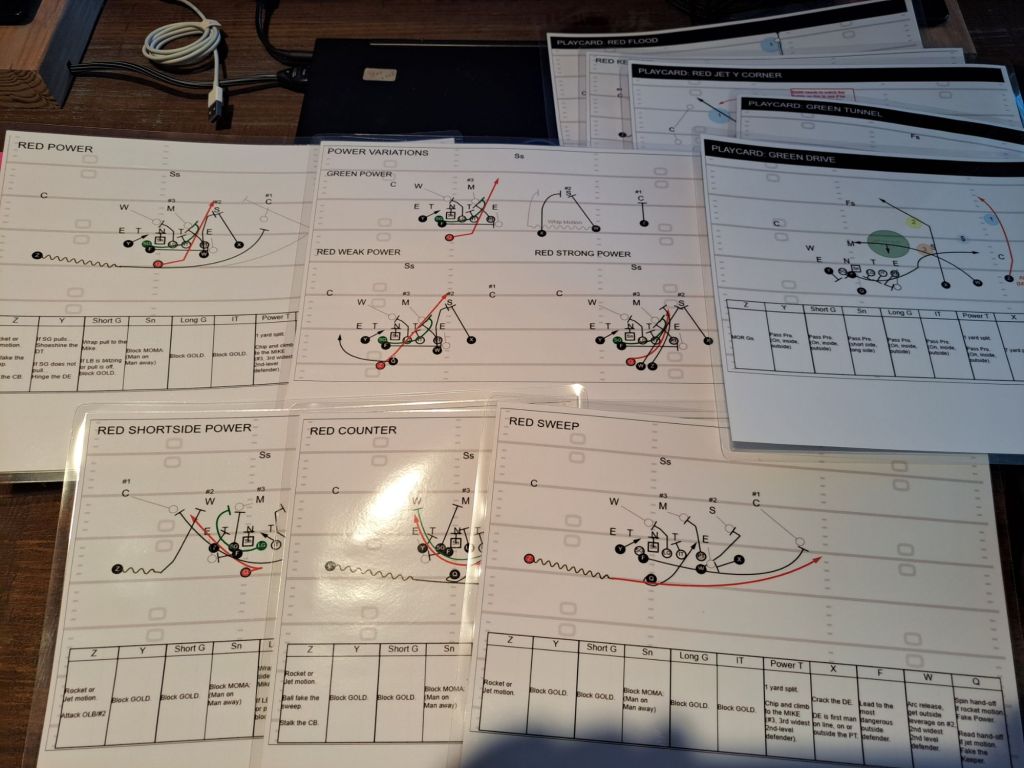
Laminated play cards!
They are waterproof and will last several weeks.
1. 9.0 to 9.5″ width laminator- $55
2. 50 thermal laminating pouches- $11
3. 8.5 x 11″ printouts of your plays
Bud Wilkinson’s Coaching Philosophy
3 National Championships & 47 consecutive wins at Oklahoma:
BUD WILKINSON THOUGHTS & QUOTES
From Legendary Virginia High School Football Coach, Bill Mountjoy
COMMON COACHING ERRORS AND HOW TO AVOID THEM
By: Bud Wilkinson
GENERAL COMMENTS: The best coach is the one who makes the fewest mistakes; the one who does the best teaching job; the one who is the best organizer. Writing the X’s & O’s is not the most important thing. There are 22 variables in a football game. Coach must be a salesman to the extent that when his team loses, they don’t blame him or the offensive and/or defensive system, but rather themselves.
ERRORS IN TEACHING METHODS:
FIRST = FAILURE TO USE TIME EFFICIENTLY. Failure to recognize the time factor available to get the job done. Planning makes for valuable use of time. Too long on any one thing produces boredom. When boredom comes in, learning goes out. Football players have a short attention span. Hold to time schedule.
SECOND = FAILURE TO EXPLAIN THE PURPOSE OF THE DRILL. Tell the boy WHY he is doing what he is trying to accomplish and he will do a better job. Explain WHY, then show HOW.
THIRD = IMPROPER TEACHING PROGRESSION. You can’t teach a boy how to block until he has learned stance. If he hasn’t learned stance, he doesn’t know how to step out of the stance into the block.
FOURTH = TOO MUCH VERBAL INSTRUCTION ON THE FIELD. How much can boy learn from your verbal instruction with his helmet on, he’s breathing hard, he aches, he’s stunned, etc. Do WHO and WHY in chalk talk. Teach assignments before hitting the field. Correct on the field. Teach — no! (HOW is taught on the field — not WHO & WHY).
FIFTH = TOO MUCH DEMONSTRATION BY COACH. How much you know is not important. How much player knows is.
SIXTH = BEING ON THE FIELD TOO LONG. Better to have a team eager to play rather than physically tired. How long to practice is a judgment factor. Cut down as season goes along — not going to change mechanical ability late in season. Only one rule never violated at Oklahoma. If one coach on staff feels practice too long, we must cut it down. More boys play poorly because they practiced too long than boys playing poorly because they didn’t practice long enough.
ERRORS IN TACTICS AND STRATEGY:
FIRST = TACTICS AND VICTORY. You get very few victories on tactics. Victories come if you can out block, out tackle, out fundamental your opponent. Red Sanders quote: “Intimidate them physically”! Outmaneuver — no. Defeat — yes.
SECOND = CLEAR CUT PHILOSOPHY A MUST. Decide on an offense and defense that will suit your personnel then stick to it. Depth of morale can be determined by a kid’s reaction to a loss. If morale deep, they’ll blame themselves. If morale shallow, they’ll blame you.
THIRD = TOO MANY PLAYS AND DEFENSES. Subtract the number of different plays used in the game from the total number of plays you practiced. If this number is too large you better get rid of some plays. It is difficult enough to know when to run off- tackle, but if you have four ways to run off-tackle, you will never get the right play. Beauty of Triple Option is it’s very limited number of plays
ERRORS IN JUDGMENT:
FIRST = BE REALISTIC ABOUT PLAYER’S ABILITY. Don’t just put an X or an O on the board. Put up the boy’s name. Immediately his limitations affect the offense or defense you put up. Whale of a lot of difference between Dick Butkus and Humpty Dumpty.
SECOND = WHEN CHIPS ARE DOWN, BEST PLAYERS ARE IN THE GAME. It is a mistake to be able to play blue chippers only one way. Say best kid you have can only go on offense. Say opponent has ball for 45 minutes. These are 45 minutes he cannot help you.
ERRORS IN OFF FIELD RELATIONSHIP:
FIRST = RELATIONSHIP WITH OTHER FACULTY MEMBERS. The environment that exists has a lot to do with winning or losing. If they are with you, your job is easier. If they are against you, you’re in trouble. Work on a program of how to win friends and influence faculty members.
SECOND = ORGANIZE A MOTHER’S CLUB. Get mother on your side by pointing out to her what he can get out of football besides winning games.
THIRD = PRESS, TV, AND RADIO. Straight up fact of life that the great majority of people get their impression of you from what they read in the paper, see on TV, or hear on radio. Their jobs depend on info. Get it to them to make their jobs easier. Get these people on your side. Let them know what you’re doing. They will interpret what you’re doing in the way you want it interpreted if they are with you.
ERRORS IN DEVELOPING MORALE (MORALE IS TO THE PHYSICAL AS 4 IS TO 1):
FIRST = FOOTBALL BEGINS WITH MORALE! Once you get morale, it is easy to maintain. How to get it is a problem.
SECOND = HOW TO LOSE MORALE. Do what you said you’re going to do. Don’t say we’re going to practice 1 ½ hours and go 2 ½ hours. Training rules — if you’re not going to enforce them, don’t have them.
THIRD = MORALE STEMS FROM DISCIPLINE (ALL Discipline begins by being on time).
FOURTH = TREAT PLAYERS AS A PERSON. If he feels you are interested in him only as a football player, he won’t go all out for you. If you are interested in his academics, his personal problems, etc. and he knows this, he’ll go all out for you. Convince him that football is good for his future.
FIFTH = One year, Knute Rockne had 2 QB’s. Under great athlete, team failed; under mediocre QB, team succeeded. Why? Captain’s reply — “the great athlete is trying to show how good HE is. The TEAM is trying to make the average guy look good”.
COACH IN YOUR OWN WAY:
FIRST = DON’T COPY! Note clinicians and their personalities. ALL different ways of being successful. Plan carefully in the off season. Can’t take golf lessons between the 8th green and 9th tee.
CONCLUDING REMARKS: The man who is best organized and does the best teaching job, is the best coach.
Pursuit Drill
If you aren’t practicing pursuit, practicing tackling form is a waste of time. My guess is less than 10% of tackles are solo form tackles. And regardless of how good our form is, we aren’t tackling anyone if we can’t get to the runner first! Therefore, we practice pursuit AT LEAST as much as tackling form, if not 2:1 or 3:1.

On Chasing That High School Coaching Job
The process of landing a head coach job can be challenging. I’ve been through the process three times, and they’ve all gone just about the same way. Here’s what I’ve learned so far…
Where to find job openings:
- Your State High School Activities Association often posts job openings for athletic positions before anywhere else. Check their website.
The Initial Screening
- The Athletic Director (AD) serves as the first screening filter. He reviews the applications that come in via the job posting. He decides who gets considered and who gets tossed back into the slush pile.
- Submit an enthusiastic letter (email) of interest that emphasizes your high school coaching experience. Augment that with other experience that demonstrates you are capable of leading a program (which is vastly more than just Xs and Os).
- If your resume is extensive, include it; if not, wait until they request it. If you submit a thin resume, they will use that to filter you out immediately.
- Include reference letters from mentors and advocates who can speak to your qualifications. Emails from your mentor coaches have the biggest impact. Your H.S. coach should be enthusiastic about helping you. If he isn’t enthusiastic, your relationship is broken. The onus is on you to fix it.
- Submit a power point deck or a 5-minute video on your high-level plan for their program.
- Incorporate THEIR logo in it
- Use pictures of their players in it
- They want to know what your ideas are for their situation. Share them! If you don’t share your vision, they will assume you don’t have any and/or that you are just looking at this job as a stopover on your journey to bigger and better things. Try to diagnose what their core challenges are and address them as if you already have the job. Do this without being critical of them.
- “We need to boost numbers! Here’s how I intend do it…”
- “We need to get this team moving the ball. Here’s what I think will work…”
- “Looks like we have a great OL coming back! I intend to make that the foundation of success next year…”
- Show them you’ve researched their program. Read their wiki and their website. How many students do they have? How successful are their other programs? Learn the names of the AD and the principal. Watch their max preps highlights. Search YouTube and Hudl for their games. Reference their key players by name. Mention their past seasons, opponents, and successes.
- There will be 10 to 30 applicants. You will need to rise above this slush pile.
- There may be an initial face-to-face meeting with the AD. Send him an example of your work… Hudl links, links to publications, certifications, etc.
- Scrub your social media of anything potentially offensive or political. This is a very polarized and sensitive era we live in. Never mix politics and football (goes without saying). If you make it through this stage, you can bet they will be looking at your online footprint. Education administrators are usually left-leaning. Whereas football coaches tend to lean right. There are many, many exceptions as well. I’m not making any commentary on who is right or wrong. The point is, they have a lot of candidates to sift through. Don’t give them a reason to filter you out. The deciders are professionals. Your opinions will not endear yourself to them even if they agree with you. Stay away from all of that. There is no benefit.
- The AD will spend a few weeks taking in applications and culling the pile to about 4 – 6 candidates.
The Panel Round (The Final 4-6 Candidates)
- Congratulations, you made it past the slush pile! You will be invited to a panel interview.
- When you show up, dress the part! Look like the leader of their program, not like some random position coach. Wear a suit, or at least a blazer and slacks! No khakis-and-a-polo, or jeans, or sneakers, or workout suit. Looking casual does not make you more relatable to them. It makes you look amateurish and can be taken by the panelists as insulting. Some young dork will show up wearing khakis. Your simple act of wearing a suit means you’ll bump them down a spot. Think like a pro. You’ll become your mindset.
- The Panel will be led by the AD and will consist of some combination of
- Athletic trainer
- Another sport coach
- A parent (or several)
- A booster
- A teacher
- A few players
- They will ask standardized questions. If they give you a sheet, keep it for future reference/practice.
- Some typical questions they will ask (be ready to answer them):
- Why do you coach?
- Why our high school?
- Describe your coaching style.
- What is your definition of success?
- I don’t think you should emphasize winning here. Instead, emphasize the process.
- What is your coaching philosophy?
- Don’t act entitled or cocky. Your Glazier certifications mean nothing to them. Build rapport by being relatable to them and their school. Act like you already work there. They don’t really care about your football accomplishments. You need them to like you. The good news is they’ll WANT to like you. Give them a reason.
- Talking points here:
- Talk about what you will do for their kids. Emphasize and frame everything you say in the context of their kids. What you want or aspire to means absolutely nothing to them. Zilch.
- When answering questions, frame your answers as if you are already in the job. Separate yourself from the other candidates with your preparation.
- Mention player names.
- Reference games and seasons as reference points.
- Know the school’s enrollment.
- Comment on the other successful programs.
- Say something positive about the facilities or academic ranking or history or tradition.
- Emphasize your experience as a benefit to the school.
- Propose your solutions to what you perceive as our problems, here.
- “I intend to boost our recruiting/numbers by…”
- “I hope to increase OUR funding by doing…”
- “I see the team’s strength as…”
- “I need plan to do the following in the first 90 days:”
- Kick off the lifting program
- Hold a team meeting
- Hold a parents meeting
- Raise OUR program’s profile
- Jump start recruiting
- Build OUR staff/assistant coaches
- Complete an equipment inventory/helmet certs
- What OUR practice will look like
- What OUR quantitative goals will be
- Pre-season
- In-season
- The feedback from the Panel Interview will be assembled and reviewed by the AD who will make a recommendation of (2 or 3 candidates) for the hiring manager (The Principal).
The Final Round (The Final 2 with the AD and Principal)
- Congratulations! You are a finalist.
- When you show up, wear a suit again. Look the part! Present yourself like a Chief Operating Officer (COO). You will definitely insult them personally if you show up in casual attire.
- Understand your interviewers
- The AD is in the role of HR recruiter.
You can win them over with YOUR plan, and/or your resume. Also by your authenticity, and by your preparation, and by your demonstrated coaching skill, and by your presentation effort. They want to know that you want THIS job and that you are not using them. You prove that to them with your prep. The AD likely got you to this point. He picked you over almost everyone else! He advocated for you or you wouldn’t be interviewing with the principal. But he can’t directly promote you while in that room. You have to promote yourself. He will try to give you cues to sway the principal. Pay attention and use them! Work with him to convince the principal. The AD wants you to win. He’s on your side. Don’t use the final interview to convince the AD. He’s already convinced. Convince the principal! - The Principal is an executive, the CEO of the school.
You win them over by proving you can actualize THEIR goals. They don’t care about your wants. They don’t care about you. They don’t care about your system unless you can show them why they should care. Appeal to his/her needs. These will be: 1) Taking program to next level or 2) rebuilding it. You have to demonstrate you can do this while managing authority effectively and instilling trust. The principal is a serious person. Don’t disregard this. They are PhDs. They will be very different in temperament from the AD. It has taken them years to rise to the top of their administration. They had to sacrifice their lives and compromise many of their ideals to get to this level. They have a vast array of responsibilities. All this hardens them. They are not idealists. They are pragmatists. They have a low tolerance for b.s. They are formidable people. Principals are first and foremost a political identity, like any corporate CEO or high-ranking bureaucrat. All of this makes them utterly risk averse. For them, one mistake can destroy a lifetime of career investment. Assume they are always inclined towards the “safest,” least disruptive choice.
- The AD is in the role of HR recruiter.
- The Final Interview is all about showing that you understand that the role goes far beyond Xs and Os and blocking and tackling. You have show you are more strategic and more capable than the other guy as a manager of human capital.
- They are likely to give you a list of questions they intend to ask and will give you a few minutes to review them beforehand. Save this list for future reference and practice. Be ready to answer these. Have real world examples.
- Here are some typical questions they will ask:
- Why do you want to coach at our school?
- How will your coaching philosophy contribute to our success?
- How will you build your staff?
- Good to have a couple dudes already committed
- Tell me about a difficult problem or situation that you have overcome in your career or life and how this gives you the tools you need to succeed in this role.
- How do you manage conflict? Share an example.
- Ask them to be more specific, to give a specific scenario.
- How do you plan to recruit and retain players?
- Have some ideas. Ultimately it always comes down to being competitive and winning
- How do you ensure player safety?
- Ask them to be more specific, to give a specific scenario.
- Give an example of a situation where you prioritized student safety.
- What specific goals will you set?
- Have quantitative goals (not wins or losses). Show how do you measure progress?
- What is your process for communicating with parents and players?
- Ask them what platform they use (Team Sideline, Team snap, Hudl, JustPlay).
- Scenarios like: A student comes to practice and is disruptive and giving minimal effort. When confronted he snaps at you. How do you handle this?
- What are the factors that will make the program successful? What factors rest entirely with the coach?
- Is there anything else you would like to share?
- If the principal is engaged, don’t talk him out of a “yes.” If the principal is not engaged with you, this is your last chance to make them reconsider. Highlight why you are different and why your way is the only way that will work. You have to convince them without looking desperate or condescending.
- Before this round, the principal will have probably already decided who he/she wants. Their time is expensive, and the interview, for them, is probably just a formality— ticking off the boxes on the process checklist. This is so that if something goes wrong, and someone later inquires about why they hired whom they hired, they can show how they followed the process. It is what it is. It’s not rudeness, it’s just administrative reality. The good news is that the door has not closed, yet. You still have the principal’s time and ear and this is a precious opportunity.
- If it’s not you going-in, you will know it the minute you enter the room judging by the principal’s level of engagement with you. Observe and process that subtlety. Don’t let it throw you off; you’re not dead yet. You still have a chance, but you have to be more aggressive.
- If the principal doesn’t show engagement, you have to go get it! This is where you come from behind and get back in the game, or you just run out the clock answering questions for 45 minutes.
- Therefore, know the program scenario well:
- The good, stable program
Wants to remain stable and contend. You better be from a similar program. You better have a conventional style. They’ll be looking for a coach with a pedigree. You need to emphasize how you are the best candidate to build on what they already have in place - The bad, chaotic program
Wants to stabilize first, and rebuild. This is the wildcard situation! This is where the perceived “safest” choice for principals is usually the WRONG choice and playing it safe just compounds the problem. In a bad program, the AD and Principal will probably diagnose the cycle as follows:- The team is uncompetitive
- Participation numbers decline
- They hire an experienced, conventional coach to “stabilize” the decline and change the trajectory
- The team solidifies briefly, but then continues to fail
- The participation numbers continue to decline
- The AD loses patience and replaces the coach
- Rinse and repeat…
- If the principal is curt and mechanical with you at the outset, then you have to use this moment as your opportunity to differentiate yourself from your competitor and get back in the game. Lead them (not tell them, not convince them, not beg them… but lead them) to the conclusion that his/her thinking is backwards and the model they have constructed will never work. YOU and only YOU offer a reality-based solution which is WINNING NOW! Show how winning (or at least competitiveness) must precede program stability. It doesn’t work the other way around. You’ve got to find a way to win games, immediately, and you have the answer.
Ultimately, no matter what anyone says, it all comes down to winning. If the team wins, all the problems of participation and angry parents and minor coach offenses and infractions go away. It’s not prudent to bring winning up much. You don’t want to over promise and under deliver. But everyone knows it is the bottom line. If you don’t have the principal’s engagement, then I believe this is the time to play the WIN NOW card.
In addition, you’ll have to tick all the principal’s “good manager” boxes as well. It will be a delicate balancing act. But if he/she doesn’t stand up when you enter the room and look you in the eye and shake your hand during introductions, and otherwise personally engage you, then you’ve got nothing to lose. Playing it safe here means you only guaranteed failure. Never guarantee failure.
- The good, stable program
After it’s all over, go home, have a beer, and pick out a couple things you could improve upon… but don’t over analyze your performance or beat yourself up over your mistakes. Mistakes are an inevitable and unavoidable part of learning. There are many factors involved with these decisions; most are beyond your control. Decisions are occasionally made over ridiculous and arbitrary parameters. Don’t waste sanity trying to understand and identify them. You can’t even begin to anticipate and address them all, and you’ll probably be wrong anyway. Just endeavor to be intelligently authentic next time, and let it play out as it will. It’s valid to be disappointed if you don’t get the job, but don’t let the process frustrate or discourage you. Just keep outworking your opponents and leave it all out on the field. And if you don’t get it this time, remind yourself that it is a numbers game, with the emphasis on “game.” Good luck!

P.S. Save everything from each interview experience. Emails, slide decks, videos, handouts,. Those items will be valuable resources the next time you interview.


 Sidesaddle Single Wing Football