Blog Archives
Refs Tend to Make Things Up
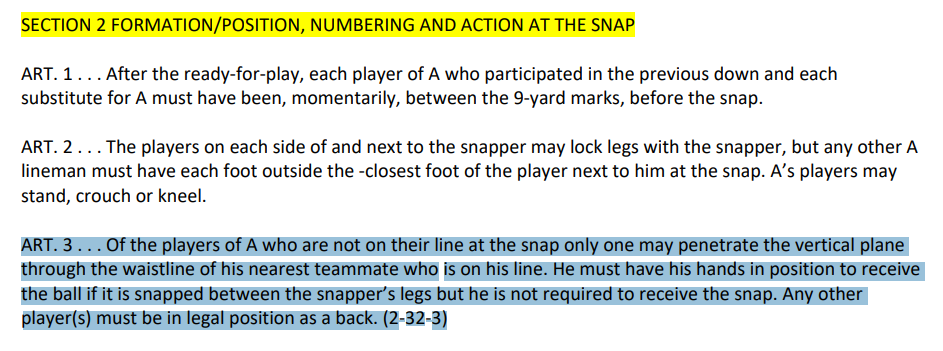
Yes, they do. They replace gaps in their understanding of rules with how they “feel” about things. It’s always best to educate them, politely of course, regarding the sidesaddle back. The sidesaddle can place his hands under center and is NOT required to receive the snap!
Rule 7, Section 2, Article 3

“Therefore, we run the ball…”
Back in the 1980s, many HS coaches sought an edge by adopting the pass-centric offensive system evolved by LaVell Edwards at BYU. His system was the pre-cursor to what Hal Mumme and Mike Leach evolved into the “Air Raid” that has been the football orthodoxy for the last 25 years. When the proper talent can be assembled (receivers, freakishly athletic OLs, and a QB) it can be an explosive force…
Without precisely the right talent, it is a shitshow.
The coaches at my high school were students of the game. They were well-prepared, knowledgeable, highly competent, motivated, and experienced. They were certain that BYU’s cutting-edge passing game was the answer to WHS’s lack of athletes. They were confident they could X-and-O the Warriors to gridiron success.
We went 0-10.
Our offense was a circus of long gains that were immediately nullified by sacks, holding penalties, incompletions, and interceptions. We could not sustain a drive, move the sticks, or flip the field. As a result, our defense was on the field, starting in our end, for 2/3 of every game.
0-10 coaches are almost always replaced. The new staff brought in a run-oriented, power/misdirection offense called the Wing T. They went 5-5 in 1988, then 10-0 in 1989.
Witnessing that turnaround had a profound impact on me.
When I started coaching, I knew I instinctively that running the ball would give my teams the best chance. I found and implemented John T. Reed’s single wing offense and my teams suddenly began to move the ball, sustain drives, and score. From there, I discovered the Double Wing through videos by Hugh Wyatt and Don Markham. They beguiled my mind and I immediately began melding their concepts into Reed’s single wing.
The last piece of evolution was the sidesaddle. After many fumbles while attempting to get a wedge snap to a sniffer back, I got frustrated and put the sniffer in the open QB stance. It immediately worked. The wedges were crisper and quicker and the kickout angles were significantly better. The sidesaddle single wing was born.
The league I coach in is isolated. It is very difficult to recruit kids from other areas. I have never been a strong recruiter, myself, and I do not really aspire to assemble an all star team. That process requires cutting players. I have never run a marginal player off and I do not even have the will to do it. I’ll leave that to the trophy-chasers. Instead, I want to see what I can do with the hand I’m dealt. You build relationships with these kids. Your heart bleeds for them. Your pride swells with them when they knock off a team vastly more talented. It’s a deeply satisfying experience for me to turn rec teams into contenders. If one must recruit an all star team to win a trophy, then so be it. I don’t begrudge them. But we have to find another way to success.
Therefore, we run the ball.
I’ve heard all the critiques of my offense a thousand times.
“That is not real football.”
“You have to pass!”
“That stupid/ugly/simplistic offense will never work in 4th grade.”
“It’ll never work in 5th grade.”
“It’ll never work in 6th grade.”
“It’ll never work in 7th grade.”
“It’ll never work in 8th grade.”
We run the same core plays in 8th grade that we ran in 2nd grade. Wedge. Power. Sweep. Counter.
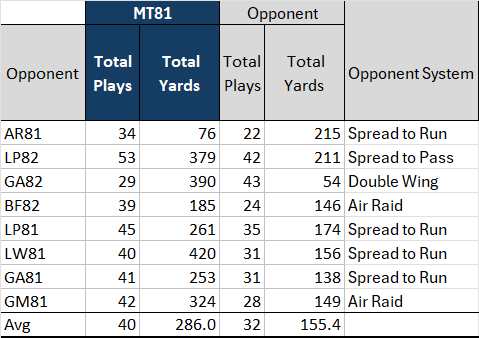
Our 8th grade team gained 286.4 yards per game… our second best output ever.
This past year, despite a 4th place schedule, our rec team out-gained every opponent we played except 1. 4 of those opponents have significant numbers of out-of-area recruits on their roster. We have zero. We are a 100% rec team. We finished 5th out of 26 teams.
People can mock and sneer all they want, but there are no “style points” awarded in football. If you want a trophy, cut your weaker players loose and go get the dudes. But if you want to make a difference for a group of kids, give them a chance to succeed. Run the ball.
VIDEO:
https://www.hudl.com/video/2/689994/66ddee81203630716602987e

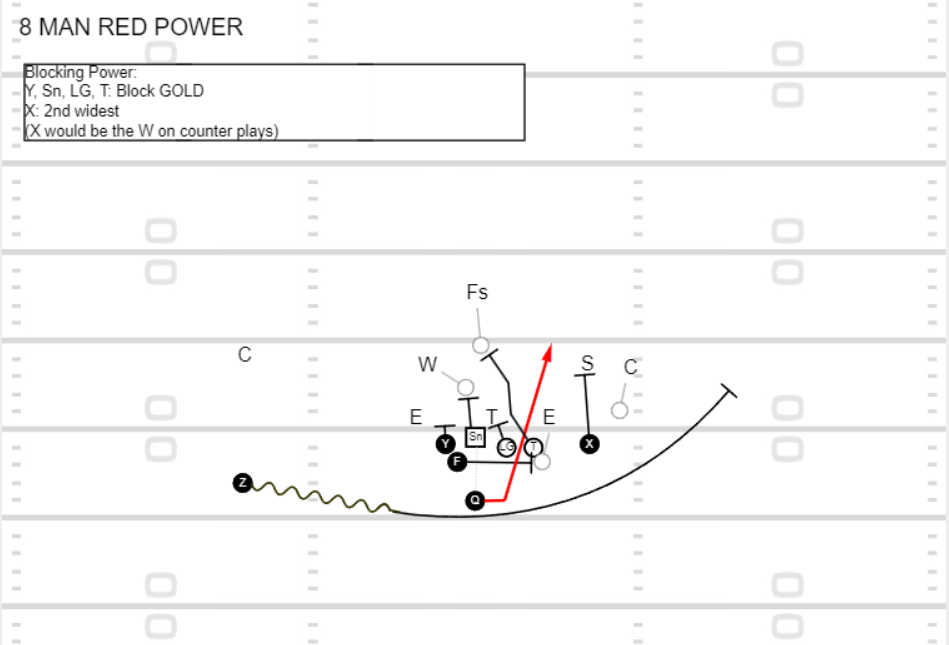
8 Man Variation
Caution: I’ve never applied this in the real world! I don’t know how the defenses will align so this is a pure guess.

Passing: The Trips Game
There is a pile of passing game tutorials and explanations available online for anyone who wishes to forage through it, but I’ve found the plays discussed in clinics and tutorials tend to be disconnected elements of the playbook offerings available. Making these concepts harmonize with a direct snap, run-oriented system can be challenging. We want our passing plays to be integrated, where one sets up the other, and each play is complimentary. Similar to our running plays, we want all the plays to start out looking the same, from the same set, then have them be able to attack the defense in different ways. For us, this renders the concept of a “route tree” as just noise adding useless complexity. We don’t need nor do we even want 729 (9^3) possible route combinations. Getting enough reps to run, let alone learn, a tiny fraction of that number is not realistic with only about 300 total passing practice reps available before the first game.
We have three well-established, proven, core passing plays out of our single wing Red and Blue set. But to evolve our passing game, we added a trips look that we think gives us more options to stress the defenses we face. But again, we don’t want to add a big bag of dozens of plays to that set. We want a tidy package of inter-related ones, a list reduced and simplified as much as possible. The greater the simplification, the easier the learning and the execution.
The defense dictates what the appropriate route combination and passing concept should be used, so we started our analysis there. We painstakingly logged every defense aligned for every play we ran out of our trips set for the entirety of our 7th grade season. We came up with 12 different defensive alignments (16+ if you count all the nuances in depth and width).
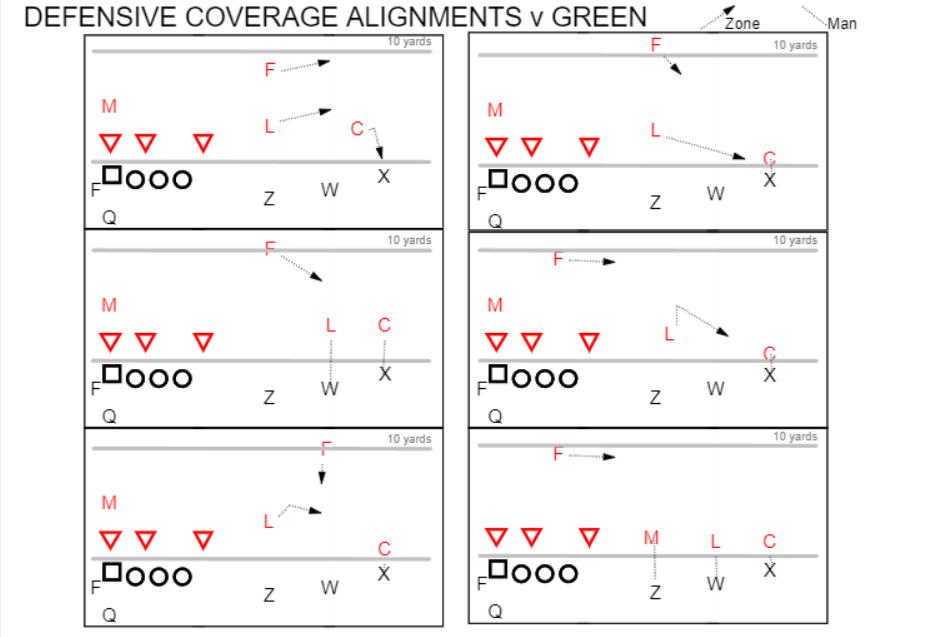

To simplify this, we created a box within the diagrams in front of each receiver. These boxes extend inside of each receiver to half the distance to the next receiver and then down field for ten yards. If a defender aligned in the box, the box was assumed “capped” or “covered” and was colored red. If no defender was aligned, we made the box green. We resolved to 5 box combinations:
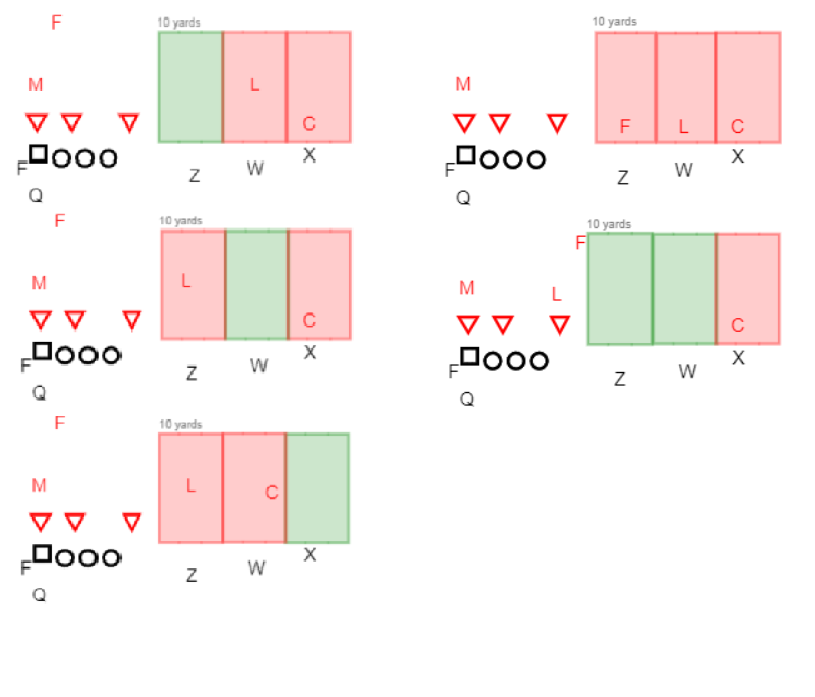
What we’re left with is a simplified key, or matrix, for play calling. If a coach or the QB can identify the occupied and empty boxes, he can make a play call that maximizes our chance for success by putting one defender into extreme conflict, creating spacing for a receiver, running an obstruction/rub/pick route combo, audibling to a running play, or throwing to the short side. Using the routes we already practice, we came up with the following options:

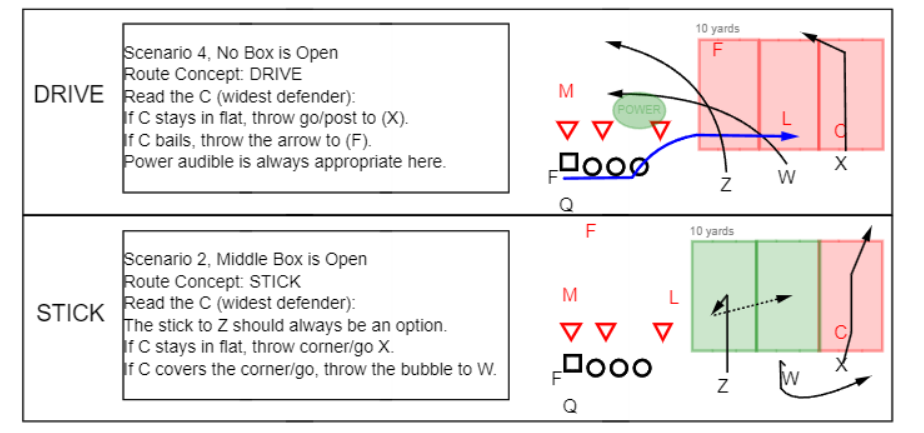
The 5 scenarios are all simple reads and call one of 4 route combinations (STICK is used twice). We’ve noticed that the SNAG leaves the bubble significantly open most of the time (62.5% on 25 of 40 times run). That’s a direct function of pulling the cover 3 CB off with the W or the CB playing too soft. So you’re probably never wrong running SNAG unless they have manned up all three receivers. If they do that, we would run all three off with DRIVE and slip the F into the flat on an arrow route. The Power audible is a tasty option if their LB is wide and if they bring 2 CBs over, then that should be an automatic Y CORNER to the short side. We’re just going to take what they give us. These are all fast-developing routes, breaking at 5-7 yards. We don’t have a lot of time… maybe three seconds.
Now, we have not installed this, yet. This is just a concept. If we are not comfortable with the Q calling pass audibles every play, we will assume their alignment from the previous play and send the play in. Or, we can read it from the sideline and hand signal the Q. Either way, we are going to give it a try. If it works, I’m going to add it to the SSSW playbook. We’ll see.




 Sidesaddle Single Wing Football