Blog Archives

Keep It Simple

A small number of plays executed well, will yield better results than a large number of plays executed adequately.
The Domino Effect

We believe our team must be able to execute each of these dominoes in order to run the ball reliably. If we cannot run, our team has failed one of these steps. We must find the failure and correct it. The earlier the step in the process, the more priority it must take when correcting.

Counter
Once we’ve controlled inside penetration and have hurt them with sweep and power, we call “Counter” for the homerun.
We try to make most plays look the same: same formation, same rocket motion, same Q spin. In this play, the Q (single wing TB) takes the snap, spins to fake handoff to the rocket running sweep, then pivots and hands to the wingback coming across the formation towards the short side.
This is an INSIDE RUN. The sidesaddle must slip under the DE and push him behind the play -or- pin him into the OL if he is crashing. The power tackle pulls from the long side to lead to the first danger that presents. There should be plenty of time to bring the power tackle across the formation.
DO NOT LET YOUR WINGBACK bounce outside before he slips under the edge player. He’s going to want to bounce outside this instinctively. If he does this in practice, make him suffer something unpleasant. 😉 If he does it in a game he will lose 5 yards.
Variations of this play are deadly for most SW and DW teams .
There Are Only 6 Route Concepts
I experienced the great benefit of being a high school assistant coach for two years on a team that ran the Mazzone version of the Air Raid offense. Although I was a defensive coach, I picked up on the core concepts by osmosis. It was reinforced upon me that passing is difficult, even in high school. There exists a predominant reliance upon the “get the ball to fast kid” strategy. That’s all good and fine, but that strategy is what I describe as “unicorn dependent.” As a coach, I just really don’t want to be reliant upon a contrast in talent in order for a play to work. So I dove in to passing concepts to see what makes route combinations work in the absence of a talent mismatch. After studying our high school playbook and watching dozens of hours of YouTubes, I’ve decided that there are really only 6 methods of getting receivers open. If I’ve missed any, please let me know and I will revise my analysis accordingly. As far as I can tell, the possible route concepts are as follows:
The Mismatch
Used against Man or Zone
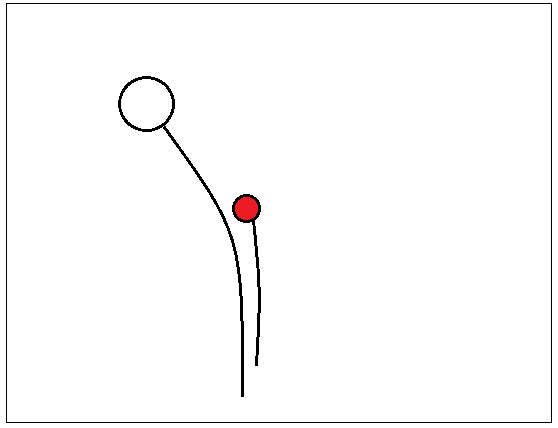
As mentioned, this is where a faster, bigger, stronger kid can make his own space to catch a ball by simply running past, leaping over, or out-muscling a weaker defender. This is the dominant passing concept at the youth level. It is a perfectly valid tactic that every coach should exploit if available to him as it is the simplest to implement. Jump balls, go routes, and 50/50 balls are examples of mismatch. If no other route concept is employed, then the route concept is based upon Mismatch by default.
Obstruction
Used against Man
This concept seeks to create receiver space by obstructing the covering defenders (within the framework of the rules) to create open space for the receiver to catch and run. Mesh, rubs, and screens utilize this concept.
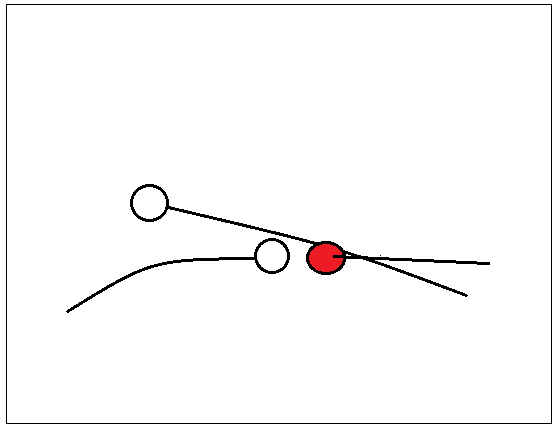
Conflict
Used against Zone
This concept seeks to force one defender to choose one of two possible receivers to cover (or forces two to cover three or three to cover four). The choice is presented simultaneously. If he chooses one, the another receiver will be open. Levels, drive, and four verticals, as well as scissors route combinations are examples of creating Conflict.
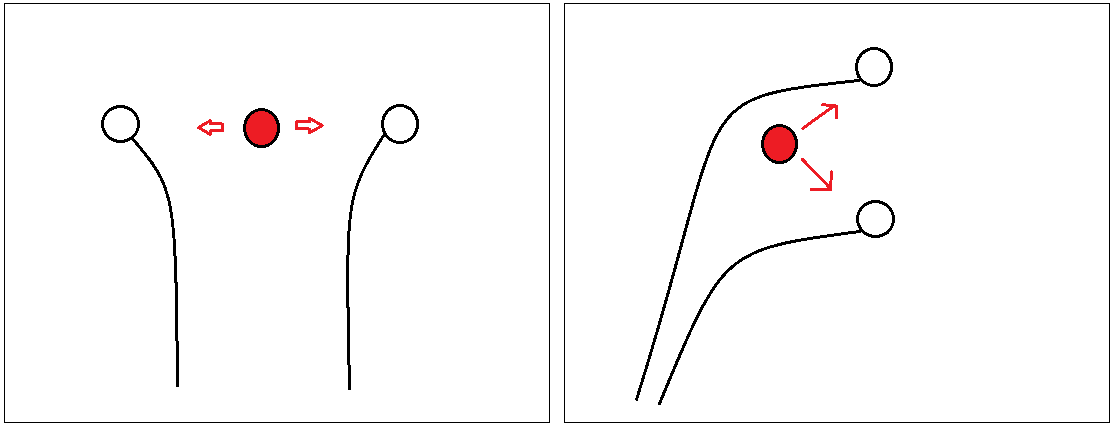
Spacing
Used against Man or Zone
This concept seeks to create space for one receiver with the route(s) run by another. It is similar to conflict but is sequential rather than simultaneous. The first route draws off the defender and the open space is then backfilled by another receiver. A clear-out, swing, wheel, checkdown, and shallow cross are forms of spacing.
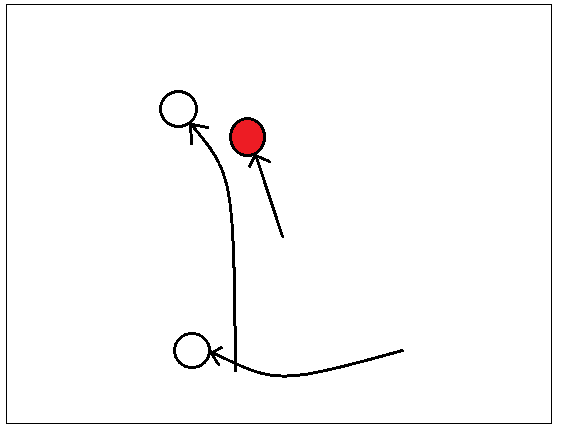
Play Action
Used against Man or Zone
This concept is related to Spacing in that it attempts to draw a coverage player off his man or a coverage zone in order to support an illusory running play. Our “Y Corner” is a form of Play Action by design.
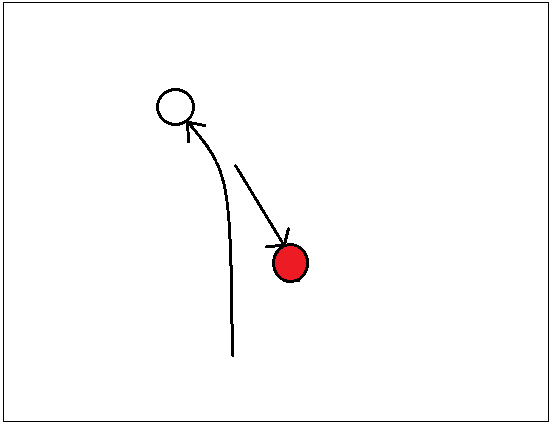
Receiver Choice
Used against Man
This concept gives an option to the RECEIVER who is reading the play of his defender. If the defender tries to take away A then the receiver exploits B. The run-and-shoot offense uses Choice routes extensively.
The 6 Route Concepts:
1. The Mismatch
2. Obstruction
3. Conflict
4. Spacing
5. Play Action
6. Receiver Choice
All route combinations attempt to leverage at least one of these six concepts. And they all must be executed within the context of time. The longer the design concept takes to develop, the greater the risk of play failure. The less athletic the offense (compared to the defense) the better the execution and timing that is required to be successful. This requires reps, reps, reps, reps, reps.
The concepts can be used in combination. Our Y Corner play utilizes both Play Action and Mismatch. Our Flood play leverages a Conflict concept against zone but we can tag it with an arrow route that adds a Spacing element. When designing pass plays, I think it’s important to build in a route concept other than The Mismatch in passing plays. If a mismatch exists, great! But the reliability and effectiveness of the play will be increased if it can be designed to incorporate another concept.


 Sidesaddle Single Wing Football