Blog Archives

On Chasing That High School Coaching Job
The process of landing a head coach job can be challenging. I’ve been through the process three times, and they’ve all gone just about the same way. Here’s what I’ve learned so far…
Where to find job openings:
- Your State High School Activities Association often posts job openings for athletic positions before anywhere else. Check their website.
The Initial Screening
- The Athletic Director (AD) serves as the first screening filter. He reviews the applications that come in via the job posting. He decides who gets considered and who gets tossed back into the slush pile.
- Submit an enthusiastic letter (email) of interest that emphasizes your high school coaching experience. Augment that with other experience that demonstrates you are capable of leading a program (which is vastly more than just Xs and Os).
- If your resume is extensive, include it; if not, wait until they request it. If you submit a thin resume, they will use that to filter you out immediately.
- Include reference letters from mentors and advocates who can speak to your qualifications. Emails from your mentor coaches have the biggest impact. Your H.S. coach should be enthusiastic about helping you. If he isn’t enthusiastic, your relationship is broken. The onus is on you to fix it.
- Submit a power point deck or a 5-minute video on your high-level plan for their program.
- Incorporate THEIR logo in it
- Use pictures of their players in it
- They want to know what your ideas are for their situation. Share them! If you don’t share your vision, they will assume you don’t have any and/or that you are just looking at this job as a stopover on your journey to bigger and better things. Try to diagnose what their core challenges are and address them as if you already have the job. Do this without being critical of them.
- “We need to boost numbers! Here’s how I intend do it…”
- “We need to get this team moving the ball. Here’s what I think will work…”
- “Looks like we have a great OL coming back! I intend to make that the foundation of success next year…”
- Show them you’ve researched their program. Read their wiki and their website. How many students do they have? How successful are their other programs? Learn the names of the AD and the principal. Watch their max preps highlights. Search YouTube and Hudl for their games. Reference their key players by name. Mention their past seasons, opponents, and successes.
- There will be 10 to 30 applicants. You will need to rise above this slush pile.
- There may be an initial face-to-face meeting with the AD. Send him an example of your work… Hudl links, links to publications, certifications, etc.
- Scrub your social media of anything potentially offensive or political. This is a very polarized and sensitive era we live in. Never mix politics and football (goes without saying). If you make it through this stage, you can bet they will be looking at your online footprint. Education administrators are usually left-leaning. Whereas football coaches tend to lean right. There are many, many exceptions as well. I’m not making any commentary on who is right or wrong. The point is, they have a lot of candidates to sift through. Don’t give them a reason to filter you out. The deciders are professionals. Your opinions will not endear yourself to them even if they agree with you. Stay away from all of that. There is no benefit.
- The AD will spend a few weeks taking in applications and culling the pile to about 4 – 6 candidates.
The Panel Round (The Final 4-6 Candidates)
- Congratulations, you made it past the slush pile! You will be invited to a panel interview.
- When you show up, dress the part! Look like the leader of their program, not like some random position coach. Wear a suit, or at least a blazer and slacks! No khakis-and-a-polo, or jeans, or sneakers, or workout suit. Looking casual does not make you more relatable to them. It makes you look amateurish and can be taken by the panelists as insulting. Some young dork will show up wearing khakis. Your simple act of wearing a suit means you’ll bump them down a spot. Think like a pro. You’ll become your mindset.
- The Panel will be led by the AD and will consist of some combination of
- Athletic trainer
- Another sport coach
- A parent (or several)
- A booster
- A teacher
- A few players
- They will ask standardized questions. If they give you a sheet, keep it for future reference/practice.
- Some typical questions they will ask (be ready to answer them):
- Why do you coach?
- Why our high school?
- Describe your coaching style.
- What is your definition of success?
- I don’t think you should emphasize winning here. Instead, emphasize the process.
- What is your coaching philosophy?
- Don’t act entitled or cocky. Your Glazier certifications mean nothing to them. Build rapport by being relatable to them and their school. Act like you already work there. They don’t really care about your football accomplishments. You need them to like you. The good news is they’ll WANT to like you. Give them a reason.
- Talking points here:
- Talk about what you will do for their kids. Emphasize and frame everything you say in the context of their kids. What you want or aspire to means absolutely nothing to them. Zilch.
- When answering questions, frame your answers as if you are already in the job. Separate yourself from the other candidates with your preparation.
- Mention player names.
- Reference games and seasons as reference points.
- Know the school’s enrollment.
- Comment on the other successful programs.
- Say something positive about the facilities or academic ranking or history or tradition.
- Emphasize your experience as a benefit to the school.
- Propose your solutions to what you perceive as our problems, here.
- “I intend to boost our recruiting/numbers by…”
- “I hope to increase OUR funding by doing…”
- “I see the team’s strength as…”
- “I need plan to do the following in the first 90 days:”
- Kick off the lifting program
- Hold a team meeting
- Hold a parents meeting
- Raise OUR program’s profile
- Jump start recruiting
- Build OUR staff/assistant coaches
- Complete an equipment inventory/helmet certs
- What OUR practice will look like
- What OUR quantitative goals will be
- Pre-season
- In-season
- The feedback from the Panel Interview will be assembled and reviewed by the AD who will make a recommendation of (2 or 3 candidates) for the hiring manager (The Principal).
The Final Round (The Final 2 with the AD and Principal)
- Congratulations! You are a finalist.
- When you show up, wear a suit again. Look the part! Present yourself like a Chief Operating Officer (COO). You will definitely insult them personally if you show up in casual attire.
- Understand your interviewers
- The AD is in the role of HR recruiter.
You can win them over with YOUR plan, and/or your resume. Also by your authenticity, and by your preparation, and by your demonstrated coaching skill, and by your presentation effort. They want to know that you want THIS job and that you are not using them. You prove that to them with your prep. The AD likely got you to this point. He picked you over almost everyone else! He advocated for you or you wouldn’t be interviewing with the principal. But he can’t directly promote you while in that room. You have to promote yourself. He will try to give you cues to sway the principal. Pay attention and use them! Work with him to convince the principal. The AD wants you to win. He’s on your side. Don’t use the final interview to convince the AD. He’s already convinced. Convince the principal! - The Principal is an executive, the CEO of the school.
You win them over by proving you can actualize THEIR goals. They don’t care about your wants. They don’t care about you. They don’t care about your system unless you can show them why they should care. Appeal to his/her needs. These will be: 1) Taking program to next level or 2) rebuilding it. You have to demonstrate you can do this while managing authority effectively and instilling trust. The principal is a serious person. Don’t disregard this. They are PhDs. They will be very different in temperament from the AD. It has taken them years to rise to the top of their administration. They had to sacrifice their lives and compromise many of their ideals to get to this level. They have a vast array of responsibilities. All this hardens them. They are not idealists. They are pragmatists. They have a low tolerance for b.s. They are formidable people. Principals are first and foremost a political identity, like any corporate CEO or high-ranking bureaucrat. All of this makes them utterly risk averse. For them, one mistake can destroy a lifetime of career investment. Assume they are always inclined towards the “safest,” least disruptive choice.
- The AD is in the role of HR recruiter.
- The Final Interview is all about showing that you understand that the role goes far beyond Xs and Os and blocking and tackling. You have show you are more strategic and more capable than the other guy as a manager of human capital.
- They are likely to give you a list of questions they intend to ask and will give you a few minutes to review them beforehand. Save this list for future reference and practice. Be ready to answer these. Have real world examples.
- Here are some typical questions they will ask:
- Why do you want to coach at our school?
- How will your coaching philosophy contribute to our success?
- How will you build your staff?
- Good to have a couple dudes already committed
- Tell me about a difficult problem or situation that you have overcome in your career or life and how this gives you the tools you need to succeed in this role.
- How do you manage conflict? Share an example.
- Ask them to be more specific, to give a specific scenario.
- How do you plan to recruit and retain players?
- Have some ideas. Ultimately it always comes down to being competitive and winning
- How do you ensure player safety?
- Ask them to be more specific, to give a specific scenario.
- Give an example of a situation where you prioritized student safety.
- What specific goals will you set?
- Have quantitative goals (not wins or losses). Show how do you measure progress?
- What is your process for communicating with parents and players?
- Ask them what platform they use (Team Sideline, Team snap, Hudl, JustPlay).
- Scenarios like: A student comes to practice and is disruptive and giving minimal effort. When confronted he snaps at you. How do you handle this?
- What are the factors that will make the program successful? What factors rest entirely with the coach?
- Is there anything else you would like to share?
- If the principal is engaged, don’t talk him out of a “yes.” If the principal is not engaged with you, this is your last chance to make them reconsider. Highlight why you are different and why your way is the only way that will work. You have to convince them without looking desperate or condescending.
- Before this round, the principal will have probably already decided who he/she wants. Their time is expensive, and the interview, for them, is probably just a formality— ticking off the boxes on the process checklist. This is so that if something goes wrong, and someone later inquires about why they hired whom they hired, they can show how they followed the process. It is what it is. It’s not rudeness, it’s just administrative reality. The good news is that the door has not closed, yet. You still have the principal’s time and ear and this is a precious opportunity.
- If it’s not you going-in, you will know it the minute you enter the room judging by the principal’s level of engagement with you. Observe and process that subtlety. Don’t let it throw you off; you’re not dead yet. You still have a chance, but you have to be more aggressive.
- If the principal doesn’t show engagement, you have to go get it! This is where you come from behind and get back in the game, or you just run out the clock answering questions for 45 minutes.
- Therefore, know the program scenario well:
- The good, stable program
Wants to remain stable and contend. You better be from a similar program. You better have a conventional style. They’ll be looking for a coach with a pedigree. You need to emphasize how you are the best candidate to build on what they already have in place - The bad, chaotic program
Wants to stabilize first, and rebuild. This is the wildcard situation! This is where the perceived “safest” choice for principals is usually the WRONG choice and playing it safe just compounds the problem. In a bad program, the AD and Principal will probably diagnose the cycle as follows:- The team is uncompetitive
- Participation numbers decline
- They hire an experienced, conventional coach to “stabilize” the decline and change the trajectory
- The team solidifies briefly, but then continues to fail
- The participation numbers continue to decline
- The AD loses patience and replaces the coach
- Rinse and repeat…
- If the principal is curt and mechanical with you at the outset, then you have to use this moment as your opportunity to differentiate yourself from your competitor and get back in the game. Lead them (not tell them, not convince them, not beg them… but lead them) to the conclusion that his/her thinking is backwards and the model they have constructed will never work. YOU and only YOU offer a reality-based solution which is WINNING NOW! Show how winning (or at least competitiveness) must precede program stability. It doesn’t work the other way around. You’ve got to find a way to win games, immediately, and you have the answer.
Ultimately, no matter what anyone says, it all comes down to winning. If the team wins, all the problems of participation and angry parents and minor coach offenses and infractions go away. It’s not prudent to bring winning up much. You don’t want to over promise and under deliver. But everyone knows it is the bottom line. If you don’t have the principal’s engagement, then I believe this is the time to play the WIN NOW card.
In addition, you’ll have to tick all the principal’s “good manager” boxes as well. It will be a delicate balancing act. But if he/she doesn’t stand up when you enter the room and look you in the eye and shake your hand during introductions, and otherwise personally engage you, then you’ve got nothing to lose. Playing it safe here means you only guaranteed failure. Never guarantee failure.
- The good, stable program
After it’s all over, go home, have a beer, and pick out a couple things you could improve upon… but don’t over analyze your performance or beat yourself up over your mistakes. Mistakes are an inevitable and unavoidable part of learning. There are many factors involved with these decisions; most are beyond your control. Decisions are occasionally made over ridiculous and arbitrary parameters. Don’t waste sanity trying to understand and identify them. You can’t even begin to anticipate and address them all, and you’ll probably be wrong anyway. Just endeavor to be intelligently authentic next time, and let it play out as it will. It’s valid to be disappointed if you don’t get the job, but don’t let the process frustrate or discourage you. Just keep outworking your opponents and leave it all out on the field. And if you don’t get it this time, remind yourself that it is a numbers game, with the emphasis on “game.” Good luck!

P.S. Save everything from each interview experience. Emails, slide decks, videos, handouts,. Those items will be valuable resources the next time you interview.


Journal: Losing Great Players
2024/07/04 Journal, Entry 1
Jack Evans was one of the best players (if not the best) that I have ever had the privilege of coaching. He was a nose tackle on a first grade team before he joined us and we converted him into a single wing tailback. In six seasons, he rushed for around 3,500 yards. He was our captain who lead his team with his actions, not his words.
On May 19, I got a text from his mom, who was our team manager and by far the best team manager I have ever seen. She asked to meet and talk. I knew immediately what it was about. We met the next day at Starbucks and that’s where Jack told me he had been chosen for a AAA hockey team and was leaving us.
Jack struggled to tell me and it was a very emotional moment for both of us, but I expressed that I was very happy for him getting this opportunity. It was going to take an extraordinary circumstance to pry him away from his football team and this was certainly it. I hope he sets the hockey world on fire. I remain his biggest fan.
But it was a figurative gut punch, to say the least.
I greatly appreciated his communication. Communication seems to be a lost art in this era of “ghosting”. I’ve been ghosted multiple times this offseason in situations where I felt communication was warranted and the expectation of it was more than reasonable.
It is what it is.
Tallying up the offseason has been tough.
We lost our star tailback/qb to hockey
We lost our starting badass middle linebacker (moved away)
We lost our starting left guard (burned out)
And we lost a key role-player (looking for a bigger role on his middle school team).
Our star blocking back/linebacker is yet to register. They assure me he is coming back but the hour is getting late and I am not so confident he will return. I think he is struggling to decide what to do and delaying his decision. He has a chronic foot injury that is also part of the calculus. Losing Weston would be a major blow.
The unknown can be the worst torture.
…but I am learning to come to terms with the fact that I allow the torture of the unknown to cause myself pointless anxiety. Players move on. New players materialize. It’s part of the deal of coaching.
Our team has been near great for 6 seasons. A team has to have a lot of great players to be great. That requires recruiting. There is just no way around that. The top team in the league added three more all stars from a rival league. I am sure the second place team added players as well. It’s not about how bad you want to win. Everybody wants to win. It’s really about what are you willing to do to win. The top tier teams in our league are in a constant arms race. That is the reality they exist in and no one can fairly judge them for it. I can choose to be resentful of our geographical recruiting disadvantage or I can choose to accept and deal with it. That choice, and my resultant attitude, is mine and mine alone. It is a thing completely within my control.
This offseason we added 4 promising players. They represent a well-spring of size and speed for us. I remain concerned that their addition is yet offset by our losses, but there is nothing more I can do about that. Valid concern is one thing. It is a motivator. Worry is another. It is a useless and distracting and destructive emotion. Yes, we have lost our leadership and are desperately thin. We can cry about that or we can set about finding new leaders and playmakers.
This experience is nothing new for any Mountain Area team. We are remote and sparsely populous with an aging demographic. This is the brutalist “WHY” behind the ugly system we choose to run. Our system is not QB or unicorn-speed dependent. It is plug-and-play. No, it will not turn MPPs into league champions, but it will get the most out of what we have. If we were to panic and switch to the Air Raid now, as some might suggest, I am certain it would be an utter catastrophe. I have seen Air Raid teams without unicorn talent. We trust our current system. It has worked for us many times before. We are going to do the experiment anyway, so we’re fixing to find out. We are not changing systems.
PERIOD.
We’ve been top division contenders for six years. We’ve taken the best teams in the state down to the wire. Are we still contenders? Probably not at this moment. We have a lot of work to do. But when it gets tough, when the ball bounces the wrong way, when we come up short on a play, when parents chide and snipe, I need to remind myself not to get discouraged and down. There are many things beyond my control and I will need to let all of those things go as fretting over them is of no use or benefit to anyone. My wife gave me a great pep talk when I was considering options. She said that I need to see this final season through because there are 16-18 other kids on the team who still believe and I would regret abandoning them. I need to maintain a beacon spirit and remain unrelenting, trusting, and ever-hopeful.
Never forget: Buddha provides.
…and any wanker can coach an all star team.

Passing: The Trips Game
There is a pile of passing game tutorials and explanations available online for anyone who wishes to forage through it, but I’ve found the plays discussed in clinics and tutorials tend to be disconnected elements of the playbook offerings available. Making these concepts harmonize with a direct snap, run-oriented system can be challenging. We want our passing plays to be integrated, where one sets up the other, and each play is complimentary. Similar to our running plays, we want all the plays to start out looking the same, from the same set, then have them be able to attack the defense in different ways. For us, this renders the concept of a “route tree” as just noise adding useless complexity. We don’t need nor do we even want 729 (9^3) possible route combinations. Getting enough reps to run, let alone learn, a tiny fraction of that number is not realistic with only about 300 total passing practice reps available before the first game.
We have three well-established, proven, core passing plays out of our single wing Red and Blue set. But to evolve our passing game, we added a trips look that we think gives us more options to stress the defenses we face. But again, we don’t want to add a big bag of dozens of plays to that set. We want a tidy package of inter-related ones, a list reduced and simplified as much as possible. The greater the simplification, the easier the learning and the execution.
The defense dictates what the appropriate route combination and passing concept should be used, so we started our analysis there. We painstakingly logged every defense aligned for every play we ran out of our trips set for the entirety of our 7th grade season. We came up with 12 different defensive alignments (16+ if you count all the nuances in depth and width).
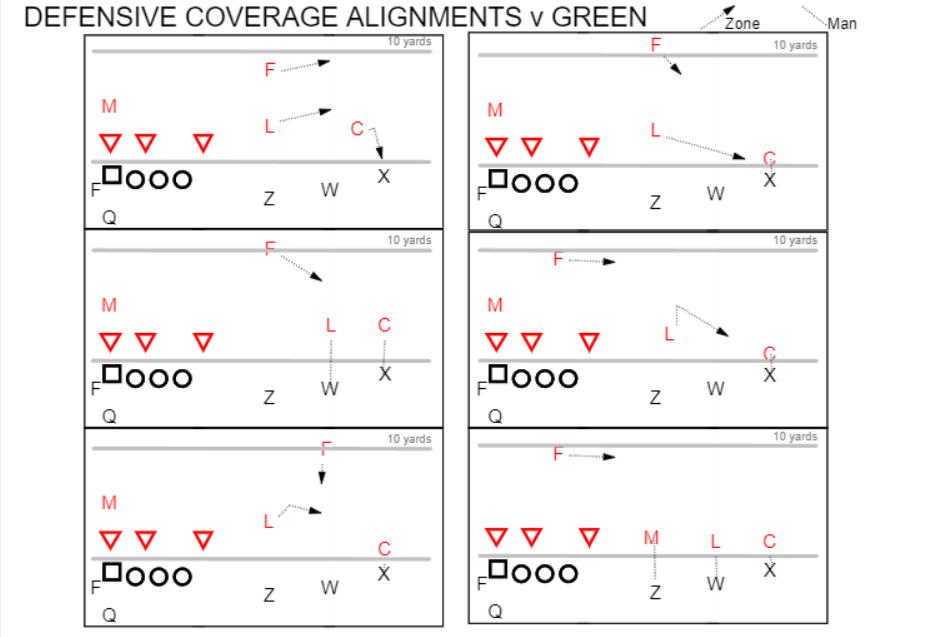

To simplify this, we created a box within the diagrams in front of each receiver. These boxes extend inside of each receiver to half the distance to the next receiver and then down field for ten yards. If a defender aligned in the box, the box was assumed “capped” or “covered” and was colored red. If no defender was aligned, we made the box green. We resolved to 5 box combinations:
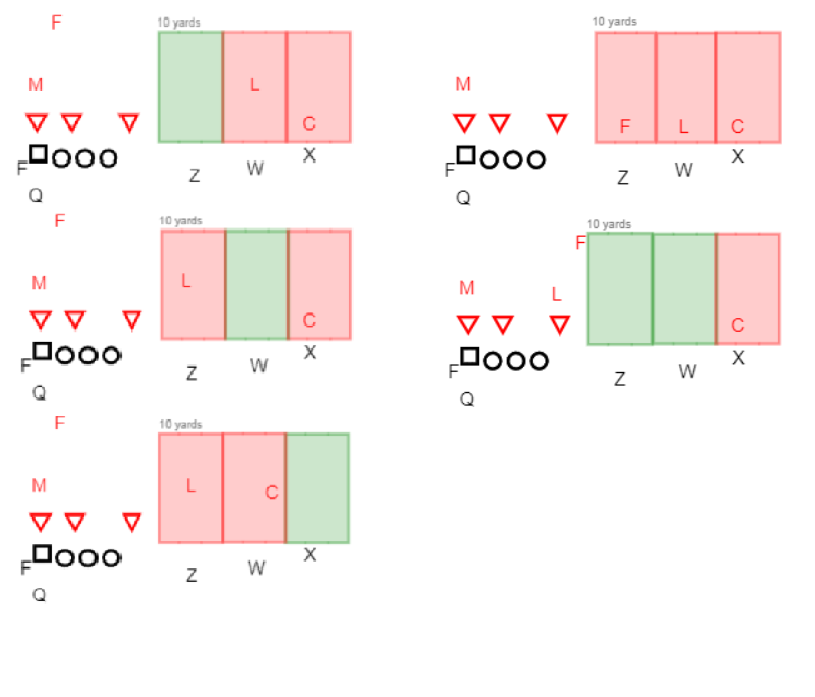
What we’re left with is a simplified key, or matrix, for play calling. If a coach or the QB can identify the occupied and empty boxes, he can make a play call that maximizes our chance for success by putting one defender into extreme conflict, creating spacing for a receiver, running an obstruction/rub/pick route combo, audibling to a running play, or throwing to the short side. Using the routes we already practice, we came up with the following options:

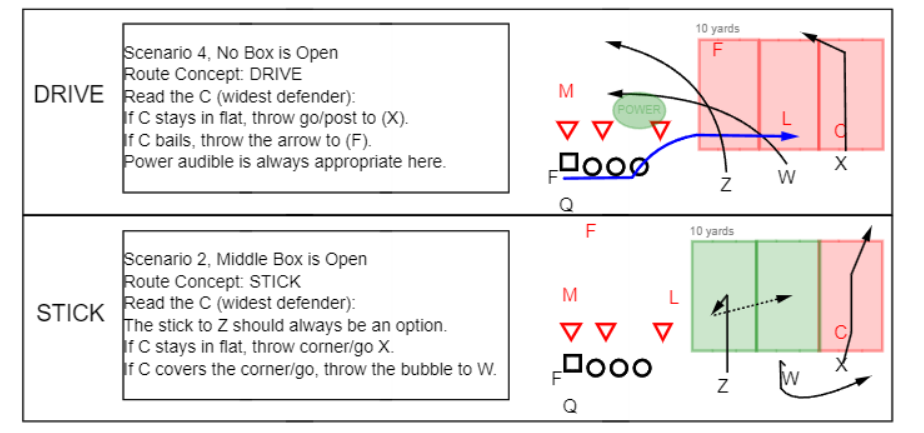
The 5 scenarios are all simple reads and call one of 4 route combinations (STICK is used twice). We’ve noticed that the SNAG leaves the bubble significantly open most of the time (62.5% on 25 of 40 times run). That’s a direct function of pulling the cover 3 CB off with the W or the CB playing too soft. So you’re probably never wrong running SNAG unless they have manned up all three receivers. If they do that, we would run all three off with DRIVE and slip the F into the flat on an arrow route. The Power audible is a tasty option if their LB is wide and if they bring 2 CBs over, then that should be an automatic Y CORNER to the short side. We’re just going to take what they give us. These are all fast-developing routes, breaking at 5-7 yards. We don’t have a lot of time… maybe three seconds.
Now, we have not installed this, yet. This is just a concept. If we are not comfortable with the Q calling pass audibles every play, we will assume their alignment from the previous play and send the play in. Or, we can read it from the sideline and hand signal the Q. Either way, we are going to give it a try. If it works, I’m going to add it to the SSSW playbook. We’ll see.

Counter
Once we’ve controlled inside penetration and have hurt them with sweep and power, we call “Counter” for the homerun.
We try to make most plays look the same: same formation, same rocket motion, same Q spin. In this play, the Q (single wing TB) takes the snap, spins to fake handoff to the rocket running sweep, then pivots and hands to the wingback coming across the formation towards the short side.
This is an INSIDE RUN. The sidesaddle must slip under the DE and push him behind the play -or- pin him into the OL if he is crashing. The power tackle pulls from the long side to lead to the first danger that presents. There should be plenty of time to bring the power tackle across the formation.
DO NOT LET YOUR WINGBACK bounce outside before he slips under the edge player. He’s going to want to bounce outside this instinctively. If he does this in practice, make him suffer something unpleasant. 😉 If he does it in a game he will lose 5 yards.
Variations of this play are deadly for most SW and DW teams .

Enhancing the Football Running Game with the Passing Game
At a bare minimum, establishing at least the threat of a passing game is critical against the best opponents. For C gap running teams like us, the lack of a passing threat invites the defense to put 10 in the box and crash their edge players in like a vice. They’ll end up squeezing all the space out of the C gap leaving us nowhere to run. The solution is to exploit the weakness they present when over-playing the run. It sounds simple.
Running the ball is a one-dimensional science in that running plays attack a point along a single line that extends left and right. Nerds describe this as a single “axis”. Running plays work positively by pushing the defenders away from or sealing defenders off from a point on that line (as with Power, Blast, Sweep plays). Or they work negatively by drawing off and spreading defenders apart along the line to create opening points (as in misdirection and stretch plays). All running play designs use one or a combination of both of these concepts.

Now, some nitpicker out there might suggest that running is two-dimensional in that successful blocking must address additional levels of the defense. But this is success is achieved sequentially, not simultaneously. The run must pass through the first line before it can pass through the second. Stated another way: a running play cannot attack the secondary level before it breaks through the front. Therefore, running is just a sequence of one-dimensional events.
Passing, on the other hand, is two-dimensional in that it is capable of attacking forward, into the defense, in addition to left and right. It can be said that passing exists on two axes, also known as a plane. This forces the defense to defend this two-dimensional space rather than just a line.
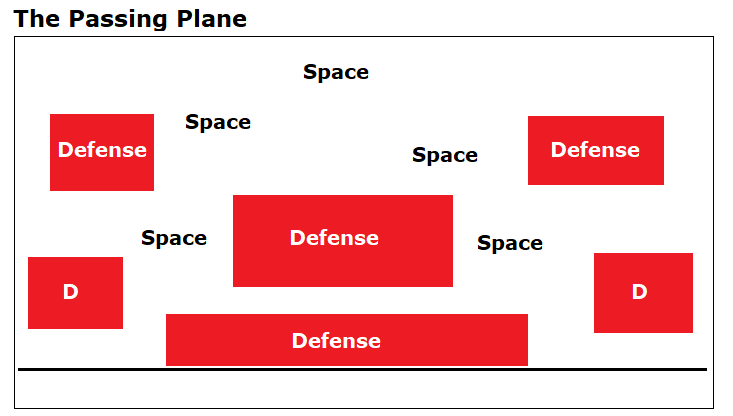
Our ability to force the defense to cover two-dimensional space is useful to draw the defenders OFF the running axis or AWAY from specific points on the running axis. The more effective our pass plays, the more the defense must honor them and the more effective our running game should be as a result.
An area (or plane) is vastly more difficult to defend than a line. But the offset is that throwing and catching is vastly more difficult than running. To be successful, a receiver must obtain enough open space in which to catch the ball without it being knocked away by the defender. The talent of the receiver and the QB, relative to the defenders, determines how much open space must be obtained. This exercise is simple for a team with a really fast kid and a QB with a strong, accurate arm versus a defender not as gifted. In this scenario, there is no coaching necessary beyond “throw the ball to the fast kid.” This is the simplest passing concept– the Mismatch. Unfortunately for most of us, we don’t usually have access to this advantage and we must design ways to get our receivers open. This process is where offensive coaches encounter another limitation: Time. Typically, the less the athletic advantage the offense has, the more complex the play designs must be to get receivers open in time. But the more complex the play design, the more time it takes to execute it. This tradeoff limits the consistency and effectiveness of almost all youth and most high school passing systems primarily because pass blocking is generally reactive and difficult to teach and thus QBs have very little time.
To prevent offensive players from obtaining the ball in one of these spaces, the defense can implement one of two (or both) of the following tactics. They can attempt to eliminate the spaces in a locational manner by assigning defenders to locations (aka “zone”) or they can eliminate spaces directly by assigning defenders to the receivers so that the open space is eliminated wherever they go (aka “man to man”).
Offenses use receiver routes to attempt to exploit the spaces the defense leaves in the pass coverage plane. The combinations of possible receiver routes can be aggregated into a single “route tree” that can be leveraged to make play calling more dynamic and flexible.
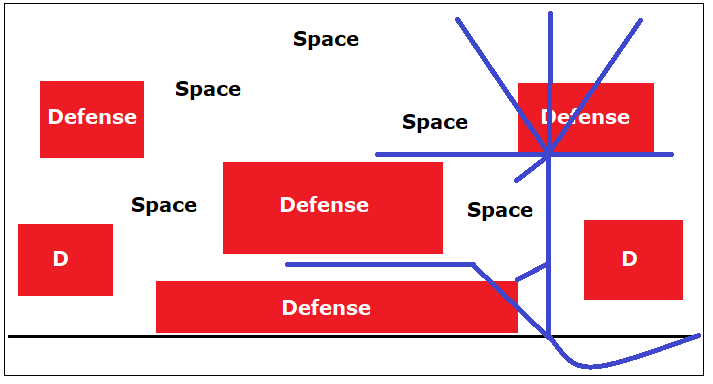
…but the defense is not static and will adjust to the receivers moving towards the openings (zone) or simply deny the openings by player assignment (man). Thus, a route tree alone will not get a receiver(s) open (unless the defense is unsound or there is a Mismatch coverage situation). Therefore, a COMBINATION of routes must be applied where at least two routes are working together to create space for at least one of the receivers. We call this a “Route Concept”.
To get receivers into space using a Route Concept requires time. The play design must increase the time available to throw or reduce the time required to get open or some combination of the two. The time to throw can be lengthened by the design of the protection or by the movement of the QB (i.e. a rollout, for instance). The time required for the receiver to get open is a function of the route combination. During grade school recess football, everyone is a receiver or pass defender except the QB. There is typically no pass rush and no pass blocking is needed. The QB has infinite time– at least until the bell rings ending recess. The primary Route Concept employed in recess football is “just run around until you get open.” In structured football, the QB has only a few seconds at best. Thus, Route Concepts must be executed successfully within a very short span of time.
So what are the Route Concepts that can be applied by route combinations to get receivers open? It seems to me they really fall into only a few categories:
Mismatch
Used against Man or Zone
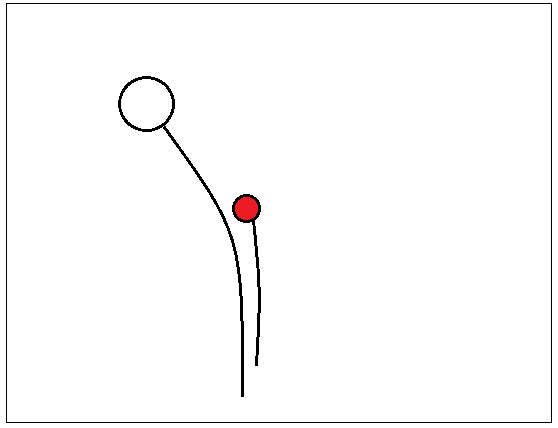
As mentioned, this is where a faster, bigger, stronger kid can make his own space to catch a ball by simply running past, leaping over, or out-muscling a weaker defender. This is the dominant passing concept at the youth level. It is a perfectly valid tactic that every coach should exploit if available to him as it is the simplest to implement. Jump balls, go routes, and 50/50 balls are examples of mismatch. If no other route concept is employed, then the route concept is based upon Mismatch by default.
Obstruction
Used against Man
This concept seeks to create receiver space by obstructing the covering defenders (within the framework of the rules) to create open space for the receiver to catch and run. Mesh, rubs, and screens utilize this concept.
Conflict
Used against Zone
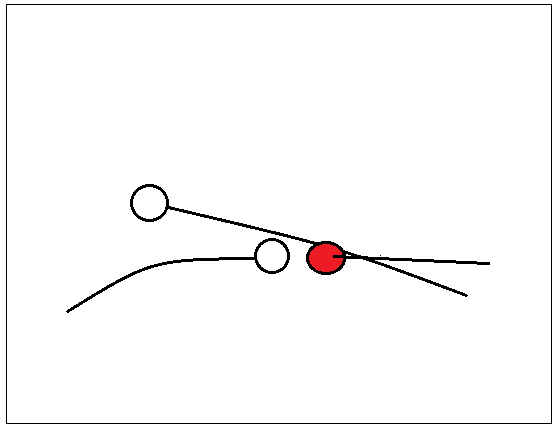
This concept seeks to force one defender to choose one of two possible receivers to cover (or forces two to cover three or three to cover four). The choice is presented simultaneously. If he chooses one, the another receiver will be open. Levels, drive, and four verticals, as well as scissors route combinations are examples of creating Conflict.
Spacing
Used against Man or Zone
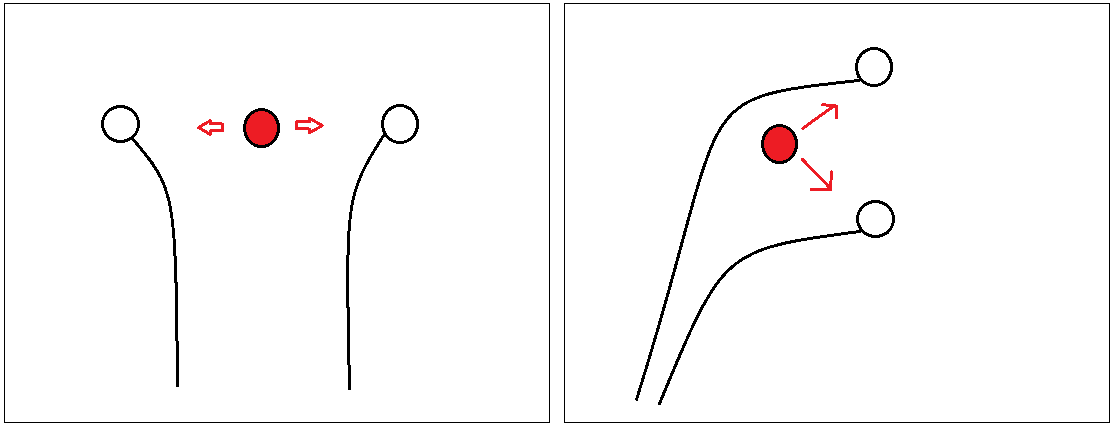
This concept seeks to create space for one receiver with the route(s) run by another. It is similar to conflict but is sequential rather than simultaneous. The first route draws off the defender and the open space is then backfilled by another receiver. A clear-out, swing, wheel, checkdown, and crossers are forms of spacing.
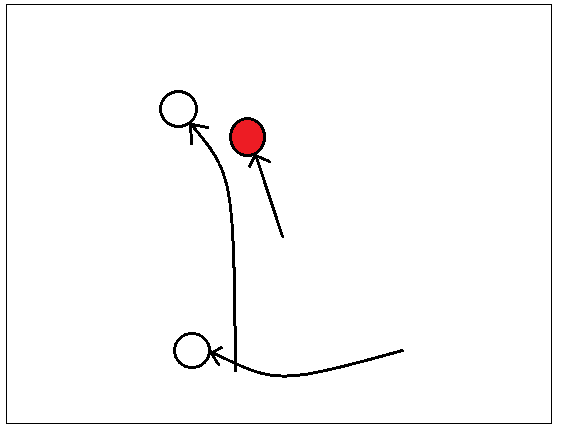
Play Action
Used against Man or Zone
This concept is related to Spacing in that it attempts to draw a coverage player off his man or a coverage zone in order to support an illusory running play. Our “Y Corner” is a form of Play Action by design.
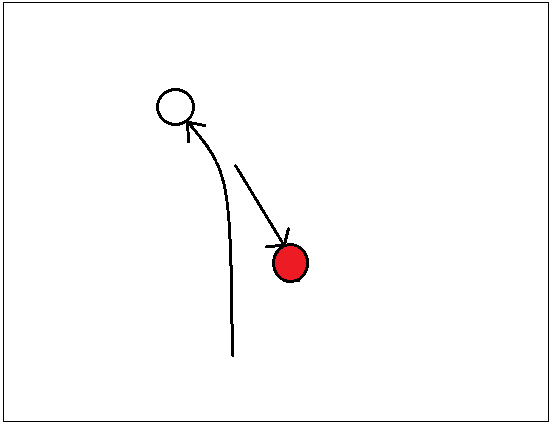
Choice
Used against Man
This concept gives an option to the RECEIVER who is reading the play of his defender. If the defender tries to take away A then the receiver exploits B. The run-and-shoot offense uses Choice routes extensively.
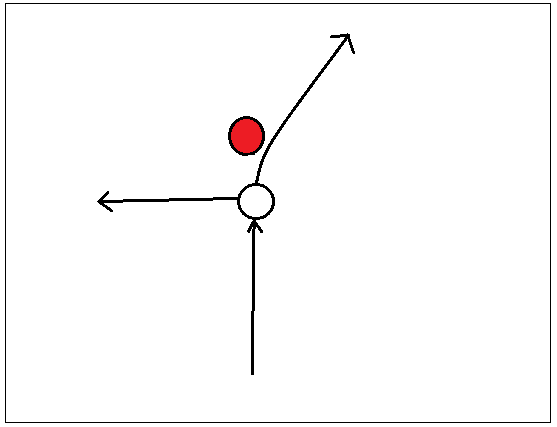
All route combinations attempt to leverage at least one of these six concepts. And they all must be executed within the context of limited time. The longer the design concept takes to develop, the greater the risk of play failure. The less athletic the offense (compared to the defense) the better the execution and timing is required to be successful. This requires reps, reps, reps, reps, reps. It is for this reason that we deem route trees to be of little marginal value IN GAME at our level. For most teams at amateur levels, introducing a novel route combination, mid game, by referencing an abstract route tree, ignores the critical importance of timing and execution that can only come from numerous practice reps. We think our passing game will be better served by adding a “Choice” route or a tag that adds an additional route to the existing plays’ route combinations rather than grab-bagging passing route combinations in the middle of a game.
Ideally, each route combination must also attempt to simplify the read of the QB. The more complex the read, i.e. the greater the range that the QB must view and process, the longer it will take to compute, and the greater the risk of play failure. If a QB’s total viewing range is 180 degrees from left sideline to right sideline, then an amateur QB should probably not be asked to read more that a quarter of it (or 45 degrees) on any given play. Consideration must also be made for obstructions of view such as linemen as well. This can make the mesh, crosser, and drive route concepts that break open in the middle of the field, in front of linemen, difficult to see and read for a younger or shorter QB.

Lou Holtz once said that “a team could put a receiver on the field with no arms and the defense will assign someone to cover him.” This has profound implications for play design! It implies that you can occupy (or remove) at least one defender from the play with a player you never intend to throw the ball to. In theory, you can remove a defender from the running axis without even intending to pass. We try to use the routes outside the narrow QB read window to draw defenders off based on the Lou Holtz premise. If the defense simply stops covering a kid, then it’s my job as coach to spot that and throw him the ball on a later play to make the defense pay. This is at the root of play-calling art and it is difficult, especially when viewing from the sideline. Anyone can call plays. It takes skill to call the RIGHT plays. Skill comes from experience. It takes lot’s of practice and discipline to train the eye to focus on the defense rather than on the ball.
We pass to open up the run and we believe passing is necessary to beat the best teams. Forcing the defense to play in a two-dimensional plane, rather than one dimension, will draw defenders off the running axis and make running the ball easier. If we can get kids open and just throw the ball at them (they don’t even need to catch it) the defense will be worried enough about it to honor the pass and pull defenders off the running axis. In the absence of the availability of a receiver mismatch, we must apply thoughtful route concepts to route combinations to get receivers open. I think any passing offense would do well to build a passing game with route combinations based on at least three of the concepts indicated above rather than just relying on a mismatch. Most importantly, any lower level passing system should be simplified as much as efficiently possible.
If you think I’m missing something let me know in the comments. I do not claim to be a passing expert. This post is part of my journey towards furthering my understanding of this great game. Likes are appreciated if it was interesting or useful.


 Sidesaddle Single Wing Football